top of page
  • Writer: Winona Rajamohan
    Winona Rajamohan
  • Dec 26, 2020
  • 5 min read

ree

If my first step to understanding discomfort is confronting existing mindsets and changing them, what should the next step be? Putting that mindset to work.


The trickiest part about shifting mindsets is building the strength to turn those hopes and aspirations sitting in my head into something tangible. Having a positive outlook on life won't change anything if I don't take the necessary steps to sustain a positive lifestyle externally. In my last post, I wrote about perception in relation to the quote "Things outside you are a projection of what's inside you, and what's inside you is a projection of what's outside" by Haruki Murakami. The same outlook applies to my life - the things I eat, the things I do, my economic privileges and limitations, the content I consume, and the ideologies it follows. All these external factors are an extension of myself, and they form a feedback loop with my thoughts and perceptions.


As I've previously mentioned, the mindset I’ve found the most success with emphasizes appreciation, intentionality, and accountability. To build an environment that cultivates this way of thinking, and to measure my success in sustaining this view of life, I need to have goals. The goals I set for myself, the way I attain them, and whether I even attain them or not — these are my best indicators to benchmark my progress.


The anatomy of a goal


I've spent a lot of time trying to perfect the way I see goals and how I should reach them. I'm extremely results-driven as a person. For that very reason, I never looked at goals as just milestones. My goals defined me, and along the way, I reduced my self-worth to nothing more than my ability to achieve goals. If you think about it logically, that's a pretty unsustainable way to go about your life.


As I graduated college, entered the workforce, and got my first real taste of life beyond the comfort of a "student" title, it became even more apparent that my goals as a young adult weren't going to be attained as quickly as my goals in college. It took a lot of courage to tell myself that my goals were going to take a lot of time, and I may not even reach them at all. If I were to only take myself seriously every time I hit a milestone, I wouldn't have much to be happy and confident about for a majority of my time alive on this planet.


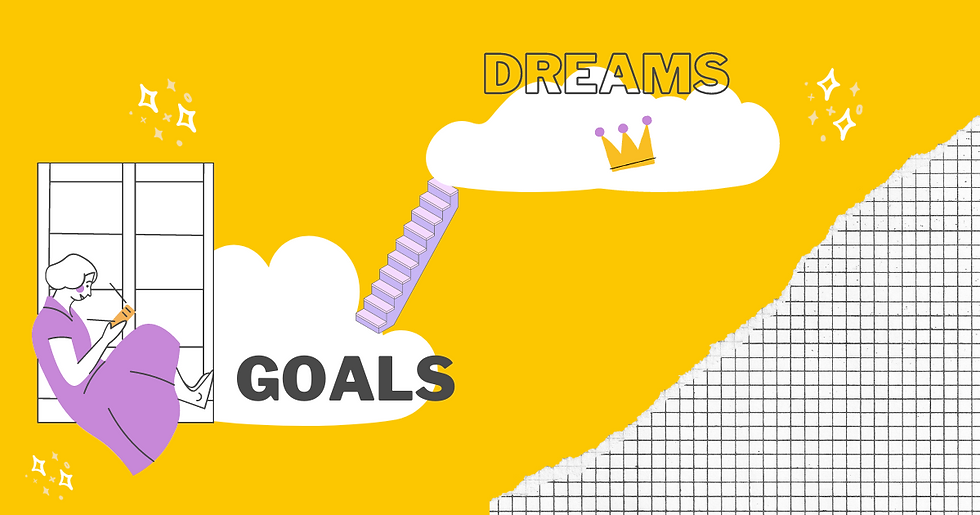
I used to look at goals as a destination, but I've learned that goals are a journey. In my eyes, a solid goal is made up of three things: an understanding of current circumstances, a self-driven desire for something better, and a realistic path to change.


ree


I always tell myself that there's a difference between a goal and a dream. A dream is the pot of gold at the end of the rainbow. Having a house like Dakota Johnson's for example is a dream. A goal is something I can do right now to get there. It's setting aside x amount of money every month for the next y amount of years so I have a realistic shot at owning a house in the near future.

My goal takes into account the fact that I may not accumulate as much income as Dakota Johnson or have the time to maintain that standard of living with more rigid corporate jobs. It does, however, give me the opportunity to accumulate what I can and reach the closest version of a dream I can get.


I've learned that the most important part of setting a goal is giving it enough room to adapt and fail. It might seem counterintuitive to set a goal up for anything but a success, but I look at it as an opportunity for the smarter allocation of emotional resources. I think it's unproductive to build a plan around a set outcome when society today is such a catalyst for change. Goals are a reflection of who we are as people, and they change and grow as we change and grow. The fluid nature of personal, communal, and organizational goals is exactly why we should be so careful about them. As people, we look to reinvent ourselves all the time (Case in point, I've tried to change my ~ vibe ~ every other month during quarantine). It's important that we pause to rethink and realign our goals as we grow to prevent them from becoming an unintended outcome. A perfect example? Think about what Facebook has become versus the idealistic future of social interaction that Mark Zuckerberg initially set out to create. An unrealistic assumption of existing social and economic circumstances in a capitalist world turned his goals into a monster far bigger than he could contain.


What influences a goal?


Goals change as people do, and as people, we tend to change for a variety of reasons. Self-improvement and a better quality of life for my loved ones are some of the more uplifting idealistic driving factors of change. Unfortunately, it's not always that clear cut. The world we live in today promotes wide-scale communication and competition, in both healthy and unhealthy amounts. As we grow in an increasingly visual and content-saturated digital environment, we've become hyperaware of all the little details in the lives of people we've never even met.


We're constantly consuming new information about others - their success stories, their failures, their habits, and likings. It's never been easier to blur the lines between what we truly want for ourselves and what would bring us closer to the idea of someone else. There has been no other era in history where humans have been this connected to each other, and somewhere along the way, a lot of us have lost our sense of individuality. On many occasions over the past few years, I've confused motivation with replication — instead of encouraging myself to learn from the values of those who succeed, I fall into an unhealthy cycle of comparison and competition stemming from my desire to achieve exactly what someone else has achieved.


So, before I decide on a goal and how it's going to impact my life, I put extra thought into making sure a goal is actually mine. Real long-lasting progress is made with self-driven intentions supported by values that are true to the heart. My goals should push me toward a better version of myself — that's the right intention to hold onto. If my intentions are not for myself but instead driven by a need to be somebody else, my goals hold less weight and become less sustainable. Goals help us keep ourselves accountable, but we can't do that if we're caught up in the way other people live their lives.


As I sit down to end another day, I tick "write a new blog" off my list of weekly goals. There are lots of little things on there — clean the house, take time for me, read a book, try a new pasta recipe. They're all goals to me, not just to-do's, and they work together to support my new outlook on life. Even a list as simple as that holds enough weight for me to wake up and end the day happier. I know now more than ever to stop and think and to never take a goal for granted.


  • Writer: Winona Rajamohan
    Winona Rajamohan
  • Dec 6, 2020
  • 5 min read

ree

Do I remember off the top of my head, the first thing that pops into mind when I wake up in the morning? I try to recall any imagery that comes into focus when light breaks through the dark heavy curtains of shut eyelids. I try to recall the textures against my skin. The warmth on the back of my neck from long strands of my thick unruly bed hair, and how it contrasts the colder movements of air against my ears.


Welcome to my personal experiment.


It's an experiment that compares two controlled situations, in which I'm the constant.


In the first experiment, I wake up every single morning and lay there for a few minutes in contemplation. Those first few seconds after I open my eyes always feel like the calm before a storm. I don't care about the soft rays of sunlight that fall onto my pillow like beautiful specks of pixie dust. I don't notice the comforting warmth of a thick duvet wrapping around bare skin. Instead, I convince myself to think about how many ways the day ahead of me could go wrong. With every second, more loose fingers of thread tighten their grip and sink me deeper into the mattress. In this first experiment, I wake up disappointed because I set myself up to be disappointed. It's a mindset that feels like reality.


In the second experiment, I wake up every single morning and lay there for a few minutes in contemplation. Those first few seconds after I open my eyes feel like an opportunity, another shot to right my wrongs and see another day. The pixie dust on my pillow feels warm against my cheek, a reminder that I made it through another day of living and loving without risk. The day ahead of me doesn't seem bleak, it excites me. How can I make the next 12 hours count? In this second experiment, I wake up grateful because I took the time to appreciate. It's a different mindset, and it gives me a different reality.


Things outside you are a projection of what's inside you, and what's inside you is a projection of what's outside. So when you step into the labyrinth outside you, at the same time you're stepping into the labyrinth inside. Most definitely a risky business.

- Kafka on the Shore (2002) by Haruki Murakami -


In Kafka on the Shore (my all-time favorite), Murakami writes about ancient Mesopotamians and how they predicted the future by looking at the shape of animal intestines. The labyrinth - an analogy mindfully modeled after the shape of a gut - was made up of an intricate twist of life outside you and life inside you. More specifically, it was about how the two were so intertwined and codependent.


I read this book when I was 15, an interesting period of young life for many of us. I wasn't too aware of my own feelings at that point, I was just stepping out of a protective cocoon for the first time on my own - a little overconfident and too trusting of people around me. This line in the book never stood out to me back then. I didn't understand its significance, only because I was yet to experience how my perceptions of the outside world would shape me as an entity. That experience came a few years after, hence the beginning of Experiment 1. A long, exhausting, drawn-out experiment that I only wrapped up a couple of months ago.


In full honesty, 2020 was a blessing in disguise. The distance I placed between myself and my surroundings was necessary to deconstruct those perceptions I always had. I had been climbing a steep jagged mountain these past few years, the kind with dark wet moss-covered rocks soft against fingertips but a lot more painful to slip on. I don't stop climbing, poking my head through layers of white fog that cloud my vision and pool around my waist to keep me from seeing beneath it. I see nothing but those rocks under my fingers and feet, I feel nothing but those rocks slicing through my skin. I perceive little of the world’s beauty beyond that fog because I can't see it. I focus only on the deep cuts I get along the journey because I it’s the only thing I can see.


ree

Experiment 2 started a few days after my birthday this past July.


The first few months of quarantine were a lot to digest. I had all this time to myself, to be with these thoughts that were now louder than ever in prolonged confinement. I didn’t know how to confront my problems without hiding behind some sort of distraction. My anxiety attacks were getting more frequent, and I was consumed with guilt seeing my husband selflessly pick up my broken pieces day in and day out. I wanted to hit a reset button. I wanted to look at the world around me with awe and excitement, not fear and resentment.


So I turned to the book that helped me feel all of this once upon a time. I read Kafka on the Shore again, eager and a little nervous about how Murakami’s magically disturbing fictitious world would seep under my skin at 23.


Things outside you are a projection of what's inside you, and what's inside you is a projection of what's outside.


It made so much more sense now.


The perceptions I project onto my reality are the outcomes of my mindset. My mindset has shaped the way I look at myself, it sets me up for all the important questions - What should I do today? How should I react to this? Why am I feeling like this? In turn, those answers shape my view of life unfolding beyond me.


Murakami placed a teenage boy, Kafka, into a mysterious entanglement of past, present, and future, forcing him to be increasingly skeptical about who he was and what was real. I found myself muttering in disagreement as I now watched Kafka rashly carry his assumptions with him without stopping to think about where he was going. I agreed with him all those years ago, but now I know. He was hungry to feel loved and embraced, but he was too impatient to understand what it meant to love and embrace.


I’ve been just as impatient all these years. I wake up hoping for the stars to align, but I’m too impatient to dissect what I could be doing differently to help them along their path. I don’t try to understand how the stars move, and it becomes difficult to appreciate how far they’ve already come from their starting point.


It’s all in the mindset, the way you think and perceive. The mindset I’ve found the most success with focuses on three things: being appreciative, knowing my intentions, and admitting my mistakes. It’s easy to take a day for granted. But when I hold onto those first few moments, precious seconds that I once easily disregarded without much thought, I see how much it means to have a ‘today’ to wake up to. I see an opportunity to learn, fuck up, and grow.


I see a better version of myself tomorrow, and that’s enough to keep me going.


  • White Facebook Icon
  • White Twitter Icon
  • White YouTube Icon

© 2023 by Designtalk. Proudly created with Wix.com

bottom of page